1. INTRODUCTION: THE ZERO-CLICK CRISIS AND THE PRESSURE ON B2B MARKETING BUDGETS IN 2026
For the past two decades, the standard B2B marketing playbook has followed what seemed to be an almost immutable formula: allocate budgets to keyword research, hire agencies to produce hundreds of SEO-optimized articles, build backlinks, push websites into Google’s top three organic search positions, attract organic traffic, guide visitors toward consultation request forms, and eventually hand qualified leads over to the sales team.
However, as we enter 2026, this traditional marketing funnel is facing one of the most significant disruptions in the history of the internet.
B2B buyers—including Chief Technology Officers (CTOs), Chief Marketing Officers (CMOs), business owners, and other C-level decision-makers—are no longer willing to click through individual websites among Google’s ten blue links just to read, consolidate, and compare information about potential vendors.
Instead, they are turning directly to AI-powered platforms such as ChatGPT, Gemini, Perplexity, and Claude, as well as Google’s AI Overviews, to ask increasingly complex business questions.
Consider a scenario that is becoming increasingly common:
“Compare three B2B CRM platforms that offer the most secure cloud infrastructure integration for a manufacturing company with 500 employees in Southeast Asia. Analyze their strengths and weaknesses, and recommend a reputable implementation provider.”
In less than five seconds, an AI system can generate a concise, relevant response, highlighting two or three leading brands and providing citations to credible information sources.
The buyer receives a comprehensive answer without having to click through any traditionally SEO-ranked websites. This is the reality of Zero-Click Search.
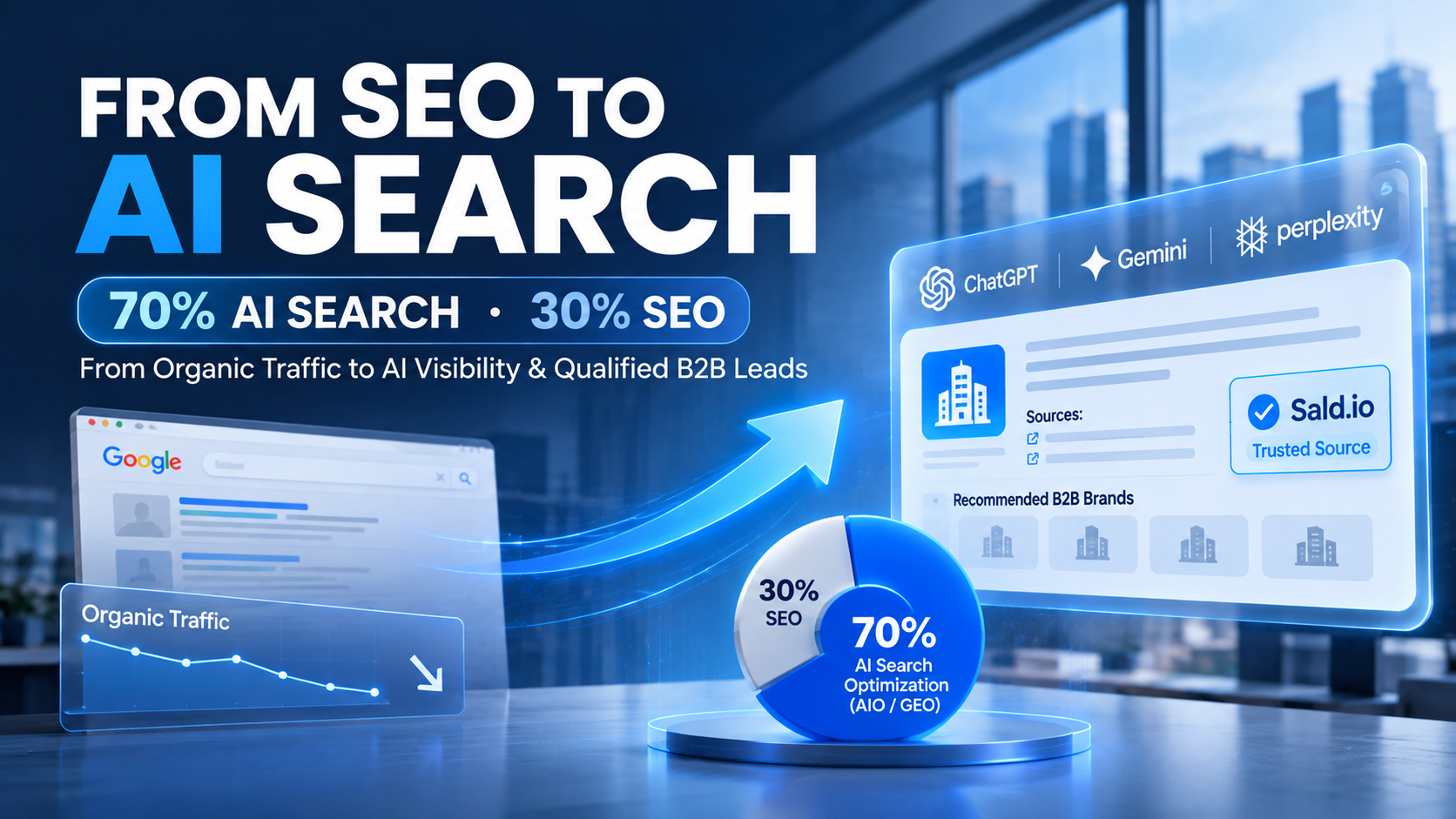
According to the proprietary Terran Labs B2B Benchmark Index (2026 Data), organic click-through rates (Organic CTR) to B2B websites from service-related informational search queries have declined by 38.4% compared with the 2023–2024 period. Meanwhile, direct searches for enterprise solutions through AI Search interfaces have surged by 215%.
This creates an urgent business challenge for B2B leaders:
Should companies continue pouring hundreds of millions of VND into traditional SEO—a channel experiencing daily declines in organic clicks—or redirect their marketing budgets toward AI Search Optimization (AIO/GEO)?
This article goes beyond theoretical discussions. From the perspective of B2B growth strategy, we will examine the fundamental differences between these two approaches, evaluate their economic implications through ROI and Customer Acquisition Cost (CAC), and present a practical framework for reallocating marketing budgets more effectively.
2. UNDERSTANDING THE FUNDAMENTAL SHIFT: FROM SEARCH ENGINES TO ANSWER ENGINES
Before making informed marketing investment decisions, business leaders must understand the fundamental technological shift between two distinct platforms: Search Engines and Answer Engines.
The Shift in Search Paradigms
+-----------------------------------------------------------------------+
|                         THE SHIFT IN MINDSET                          |
+-----------------------------------------------------------------------+
|                                                                       |
| TRADITIONAL SEO              --->       AI SEARCH OPTIMIZATION        |
|                                                                       |
| - Keyword ranking algorithms             - RAG-based synthesis        |
| - Returns a list of URLs                  - Delivers direct answers   |
| - Users read and synthesize information  - Provides answers and       |
|                                             source citations          |
| - Primary goal: Organic Traffic           - Primary goal: AI Share    |
|                                             of Voice (AI-SoV) & CVR   |
|                                                                       |
+-----------------------------------------------------------------------+
2.1. Traditional SEO: The “Signposting” Model (Indexing & Ranking)
The fundamental objective of traditional Google Search is to crawl, index, and rank web pages based on hundreds of signals, including keywords, backlinks, page experience, PageSpeed, and E-E-A-T.
When a user enters a query, Google essentially acts as a guide, returning a list of URLs it considers most relevant. Users must then click through individual links, read the content, and evaluate the information themselves.
In this model, businesses compete primarily for visibility and rankings within search engine results pages (SERPs).
2.2. AI Search Optimization (AIO/GEO): The “Analyze and Synthesize” Model (RAG Systems)
AI Search platforms such as ChatGPT, Perplexity, and Gemini operate using RAG (Retrieval-Augmented Generation) technology in combination with Large Language Models (LLMs).
When an AI system receives a user query, it typically goes through several stages:
- Rather than simply matching individual keywords, AI analyzes the broader context and intent behind the query through a process known as Query Fan-out.
- It retrieves relevant information from potentially millions of credible online sources, depending on the platform’s search and retrieval capabilities.
- It independently reads, synthesizes, compares, and generates a coherent answer.
- It provides source citations alongside relevant claims, facts, and brand references, allowing users to investigate the original information when necessary.
The Terran Labs Perspective: In the era of AI Search, B2B companies are no longer competing solely to secure the number-one position on a search results page. They are competing to become Authoritative Entities—trusted sources of structured knowledge that AI systems recognize and prioritize when generating answers.
3. A COMPREHENSIVE COMPARISON: TRADITIONAL SEO VS. AI SEARCH OPTIMIZATION (AIO/GEO)
To help C-level executives make informed decisions before approving their 2026 marketing budgets, let’s examine how these two approaches differ across multiple dimensions.
Capability and Return on Investment (ROI) Comparison
| Comparison Criteria | Traditional SEO (Search Engine Optimization) | AI Search Optimization (AIO / GEO / LLMO) |
|---|---|---|
| Primary Objective | Improve keyword rankings and increase organic website traffic. | Increase brand visibility through AI Share of Voice (AI-SoV) and earn AI citations. |
| Target Systems | Search engine crawlers such as Googlebot and Bingbot. | LLMs and RAG-based retrieval systems, including ChatGPT, Gemini, Claude, and Perplexity. |
| Content Format | Long-form web pages and articles, typically 2,000+ words, optimized around target keywords. | Modular knowledge structures, including Semantic Knowledge Blocks, Evidence Tables, and JSON-LD Schema. |
| User Experience | Users click links, navigate between pages, scroll through content, and find information themselves. | Users receive synthesized answers immediately and only click cited sources when they need deeper verification. |
| Key Performance Indicators (KPIs) | Organic Impressions, Organic Clicks, Keyword Rankings, and Bounce Rate. | AI Mention Rate, Citation Link Share, Brand Sentiment Score, and AI-Referral Conversion Rate (CVR). |
| Traffic Quality | High traffic volume, but often with a relatively low proportion of qualified B2B leads and significant amounts of irrelevant traffic. | More selective, qualified traffic with substantially stronger buying intent. |
| Long-Term Asset Resilience | Rankings can be significantly affected by Google’s Core Updates. | Potentially more sustainable when supported by consistent, verifiable information and strong entity relationships across AI-accessible knowledge sources. |
3.1. Core Objectives and Performance Measurement (KPIs)
The most important difference between traditional SEO and AIO/GEO lies in what marketing teams measure and how they define success.
- Traditional SEO: Marketing teams typically report performance using metrics such as: “Our website generated 100,000 organic visits this month, with 50 keywords ranking in Google’s top three positions.” However, the underlying reality may be that 95% of this traffic comes from generic informational blog posts that generate little to no Request for Proposal (RFP) activity.
- AIO/GEO: Reporting shifts toward AI Share of Voice (AI-SoV). In practical terms, this measures how frequently your brand is mentioned or cited when B2B buyers ask 100 industry-related questions across platforms such as ChatGPT and Gemini.
AI Search Referral Traffic may be lower in volume, but it can deliver significantly stronger conversion performance. According to the Terran Labs B2B Benchmark Index 2026, AI Search traffic generates consultation form submissions at a rate 3.2 times higher than conventional organic traffic.
3.2. Content Distribution and Information Retrieval
Traditional SEO has historically relied heavily on keyword placement, keyword density, and related terms such as LSI Keywords.
AI Search, by contrast, places greater emphasis on factual accuracy (Factuality) and verifiability (Verifiability).
AI systems are more likely to extract information efficiently from content structured around a Conclusion-First approach, where the main answer appears upfront and supporting evidence is presented in clearly organized formats such as Evidence Tables.
The objective is no longer simply to include the right keywords. It is to make information sufficiently clear, credible, and structured for AI systems to understand and retrieve.
3.3. Content Development and Structuring
One of the most significant differences between traditional SEO and AIO/GEO lies in how machines interpret and process content.
Traditional SEO: Optimized for Search Engine Crawlers
- Linear Content Structure: Content is typically presented as long-form articles of 1,500–3,000 words. These articles often begin with broad introductions, move into general definitions, and only then address the main topic in detail.
- Keyword Placement Techniques: Optimization relies heavily on keyword density (typically 1–3%), related search terms and LSI Keywords, as well as keyword-focused heading structures such as H1, H2, and H3.
- Extended On-Page Engagement: Some content strategies prioritize lengthy explanations to keep visitors on the page longer (Time on Page), with the intention of supporting positive engagement signals.
AI Search Optimization: Optimized for RAG Algorithms and LLMs
- Modular Knowledge Structures (Semantic Knowledge Blocks): Content should be divided into independent, self-contained information units. Rather than processing an entire article as a single block, AI systems may retrieve and process individual content segments through a technique known as Chunking.
- Conclusion-First Writing: The first one or two sentences of each section should provide a direct answer (Direct Answer), followed by supporting explanations, evidence, and relevant context.
- Evidence Tables and Comparison Frameworks: Instead of relying on lengthy descriptive paragraphs, information is organized into concise comparison tables, data cards, and structured evidence blocks. These formats make key information easier for AI systems to identify and extract.
- Context-Rich JSON-LD Schema Implementation: Terran Labs applies its SALD (Structured AI-Readable Data) methodology to structure and declare business entities. This helps AI systems correctly identify relationships between the Terran Labs brand, its RaaS services, and relevant B2B business challenges without confusing them with unrelated entities.
The key principle is straightforward: content must be designed not only for human readers but also for machine interpretation, retrieval, and verification.
3.4. Customer Acquisition Cost (CAC) and Long-Term Value (LTV)
The economic implications of this shift are equally important.
- Traditional SEO: Customer Acquisition Cost (CAC) continues to rise as competition for Google Ads placements intensifies and businesses increase spending on large-scale content production.
- AIO/GEO: Initial investments in restructuring and organizing corporate knowledge assets may be comparable. However, over time, CAC per qualified B2B lead can decrease by up to 42%, as AI-generated answers help establish credibility and influence purchasing decisions earlier in the buyer journey.
For B2B leaders, the question is no longer simply how much traffic a marketing channel generates. It is how efficiently that channel turns visibility into qualified business opportunities.
4. A DEEPER LOOK: FIVE RISKS OF ALLOCATING 100% OF YOUR B2B MARKETING BUDGET TO TRADITIONAL SEO
If your company is still following an outdated marketing allocation model—spending 80–90% of its digital marketing budget on conventional SEO articles and backlink building—it is time to reconsider.
Here are five strategic risks worth examining.
4.1. The Declining Value of Long-Tail Keyword Traffic
In the past, articles targeting long-tail keywords, such as “How to Choose Warehouse Management Software for a Logistics Company,” were considered valuable sources of organic traffic.
Today, AI-powered search experiences can answer many of these specific questions directly within their interfaces.
Users have increasingly fewer reasons to visit your website simply to read a 1,500-word informational article when an AI system can provide a synthesized answer immediately.
As a result, businesses that depend heavily on long-tail informational traffic face growing pressure on their traditional organic acquisition model.
4.2. The “Spam Content” Trap and the Risk of Losing AI Trust
Many SEO agencies now rely heavily on automated AI tools to produce hundreds of articles every month in an attempt to dominate keyword coverage.
This approach can quickly become a self-defeating strategy.
RAG-based systems used by platforms such as ChatGPT and Perplexity are designed to retrieve and prioritize relevant information. Content quality, source credibility, and the availability of supporting evidence all matter.
When a website is filled with mass-produced AI content that merely recombines existing information without original research, proprietary data, or verifiable evidence, its credibility can be undermined. Such content is less likely to become a preferred citation source.
+-----------------------------------------------------------------------+
|                   THE DANGEROUS SPIRAL OF SPAM CONTENT                |
+-----------------------------------------------------------------------+
|                                                                       |
| Overreliance on AI-generated low-quality content                      |
|                         |                                             |
|                         v                                             |
| Google quality-related algorithmic penalties                          |
| (Helpful Content systems and related updates)                         |
|                         |                                             |
|                         v                                             |
| Reduced credibility and trust signals                                 |
|                         |                                             |
|                         v                                             |
| Lower likelihood of being retrieved or cited by AI systems            |
|                                                                       |
+-----------------------------------------------------------------------+
The real danger is not simply producing content with AI. It is producing content without meaningful expertise, original insights, or verifiable information.
4.3. Declining Conversion Rates When Targeting C-Level Buyers Ineffectively
Senior B2B decision-makers have limited time.
When using AI Search, they expect expert insights, supporting data, and objective comparisons—not generic explanations that require them to spend additional time identifying the information that actually matters.
If your brand only appears through conventional SEO content filled with broad introductions and lengthy, unfocused explanations, you risk losing their trust at the very first point of contact.
For this audience, relevance, credibility, and the ability to communicate business value directly are essential to influencing purchasing decisions.
4.4. Losing Control of Your Brand’s Representation in AI-Generated Answers
Perhaps the most dangerous consequence of neglecting AIO/GEO is this:
Your competitors may end up shaping how AI systems describe your industry—and which brands they recommend.
Imagine a competitor that has already invested in well-structured AI-readable data and authoritative content.
When a potential customer asks an AI system:
“Which company provides the best Cloud ERP solutions in Vietnam?”
The AI may highlight your competitor, explain its strengths, and recommend its services while leaving your brand out of the conversation entirely.
You may lose a valuable opportunity at the AI-driven recommendation stage without even realizing that the interaction took place.
4.5. Wasting Human Resources on Outdated Manual Processes
Is your Content Marketing team still spending eight hours a day writing SEO articles based on a checklist from 2018?
That represents a significant waste of organizational resources.
Rather than focusing primarily on repetitive content production, marketing professionals need to develop into Knowledge Architects—specialists who can extract proprietary business insights, organize internal data, and transform that knowledge into machine-readable formats (AI-Readable Formats).
The future of content operations is not about producing more articles. It is about making the organization’s expertise more accessible, structured, and valuable.
5. THE 2026 B2B MARKETING BUDGET REALLOCATION STRATEGY: THE 70/30 BUDGET MATRIX
We are not recommending that businesses eliminate 100% of their traditional SEO budgets overnight.
A successful strategic transition requires continuity, adaptation, and a gradual upgrade of existing marketing capabilities.
Terran Labs proposes the 70/30 Budget Transition Matrix as a practical framework for B2B businesses.
The 2026 B2B Marketing Budget Allocation Matrix
+-----------------------------------------------------------------------+
|              2026 B2B MARKETING BUDGET ALLOCATION                     |
+-----------------------------------------------------------------------+
|                                                                       |
|   [30% BUDGET: MAINTAIN TRADITIONAL SEO INFRASTRUCTURE]               |
|                                                                       |
|   - Optimize Technical SEO, PageSpeed, and Mobile-Friendliness.       |
|   - Maintain visibility for branded keywords.                         |
|   - Improve existing landing page UX/UI and conversion paths.         |
|                                                                       |
|   [70% BUDGET: INVEST IN AI SEARCH OPTIMIZATION (AIO/GEO)]            |
|                                                                       |
|   - Structure corporate knowledge using Schema JSON-LD and SALD.      |
|   - Develop Conclusion-First content and Evidence Tables.             |
|   - Produce proprietary research and B2B benchmark reports.           |
|   - Invest in RaaS (Resource as a Service) and MCP Integration.       |
|                                                                       |
+-----------------------------------------------------------------------+
5.1. The Budget Transition Framework
30% of the Budget: Maintain and Optimize Traditional SEO Infrastructure
The objective is to preserve the technical foundation and existing search visibility that continue to support your digital presence.
Key priorities include:
- Maintaining website technical health through Technical SEO, including page loading speed, URL structure, and HTTPS security.
- Protecting branded keyword visibility and ensuring that your brand remains discoverable through Google Search.
- Improving the conversion experience and UX/UI of existing landing pages to maximize the value of current traffic.
70% of the Budget: Accelerate Growth Through AI Search Optimization (AIO/GEO)
The remaining budget should focus on building the knowledge assets and capabilities required to compete effectively in AI-driven search environments.
Key investment priorities include:
- Building Proprietary Knowledge Assets (Proprietary Data): Invest in surveys, internal research, and original studies to produce industry benchmark reports. These resources provide valuable, evidence-based information that AI systems can retrieve and cite.
- Standardizing AI-Readable Data (SALD & Schema): Restructure product information, service descriptions, pricing, and case studies into context-rich, machine-readable data formats.
- Developing Expert-Led Content (Thought Leadership Content): Move beyond conventional SEO article production and invest in in-depth analysis that directly addresses real B2B business challenges.
- Multi-Channel Distribution and Content Repurposing: Extract key insights from AIO-focused articles and transform them into expert-led short-form videos for platforms such as Facebook and LinkedIn, extending brand visibility across multiple customer touchpoints.
5.2. Transforming Existing SEO Content into AI-Readable Assets
Does your company already have 200 SEO articles published on its blog?
Don’t delete them. Instead, apply Terran Labs’ three-step content transformation process.
Step 1: Lead with the Conclusion (Conclusion-First)
Add a concise, three-to-four-sentence summary at the beginning of each article, providing a direct answer (Direct Answer Summary) to the primary question addressed.
Step 2: Introduce Evidence Tables
Convert lengthy descriptive paragraphs into concise, structured comparison tables supported by relevant figures and data.
Step 3: Implement Schema and Entity Markup
Add structured data using Schema JSON-LD to help machines understand which business entity the article belongs to and how its content relates to that organization.
This approach allows businesses to preserve the value of their existing content investments while making their knowledge assets more accessible to AI systems.
6. THE TERRAN LABS SOLUTION ECOSYSTEM: HELPING B2B BUSINESSES GAIN A COMPETITIVE EDGE IN THE AI SEARCH ERA
At Terran Labs, we do not view AIO/GEO as a short-term marketing tactic.
We are building a comprehensive End-to-End Infrastructure ecosystem that helps B2B businesses take control of the entire customer journey—from the moment a prospect discovers their brand through AI Search to the automation of subsequent conversion processes.
The Terran Labs Solution Ecosystem
+-----------------------------------------------------------------------+
|                  THE TERRAN LABS SOLUTION ECOSYSTEM                   |
+-----------------------------------------------------------------------+
|                                                                       |
|    [RaaS]        --->    [SALD / BOX CARD]    --->  [ENTERPRISE MCP]  |
|                                                                       |
| Strategic AIO            AI-Readable Knowledge      AI Agent          |
| Operations               Data Structuring            Infrastructure   |
|                                                     Integration       |
|                                                     & Lead Conversion |
|                                                                       |
+-----------------------------------------------------------------------+
6.1. Terran Labs RaaS (Resource as a Service): End-to-End AIO Campaign Management
B2B businesses often struggle to recruit professionals who combine deep industry expertise with a strong understanding of AI retrieval technologies and RAG algorithms.
Terran Labs’ RaaS (Resource as a Service) provides a dedicated team of specialists to help businesses address this challenge.
Our team focuses on:
- Continuously researching changes in the algorithms and search capabilities of ChatGPT, Gemini, Perplexity, and Claude.
- Measuring and monitoring your brand’s AI Share of Voice (AI-SoV) on a monthly basis.
- Executing multi-layered content coverage strategies through Query Fan-out Strategy, helping ensure that your brand is represented across relevant AI-generated recommendations.
Rather than building every capability internally, businesses can access specialized resources to manage and continuously improve their AI Search presence.
6.2. SALD Sales Automation Platform: Optimizing B2B Conversion Processes
Earning citations from AI Search is only the first step in attracting potential customers.
To turn that visibility into actual revenue, B2B businesses need an effective sales management and automation solution.
SALD is an autonomous marketing and sales solution developed by Terran Labs.
SALD connects a database of more than 5 million Japanese companies with its CRM system, automates email outreach campaigns, and closely tracks customer engagement—including email opens, link clicks, and website interactions.
More importantly, through its built-in MCP Server, AI models such as ChatGPT, Claude, and Gemini can retrieve and analyze sales data directly within conversational interfaces.
This enables businesses to automate the entire process, from lead filtering and qualification to advancing sales opportunities, within a secure infrastructure that remains fully under the company’s control.
6.3. BOX CARD: Structuring Product Data for AI-Powered Citations
Are your product or service pages too lengthy and difficult to navigate?
Terran Labs’ BOX CARD solution transforms complex B2B product features and service offerings into modular Knowledge Cards.
AI Search systems can more easily identify, retrieve, and extract information from these structured knowledge units. This makes BOX CARD particularly useful when AI systems generate solution comparisons and recommendations for users.
By organizing product and service information into clear, self-contained modules, businesses can make their offerings easier for AI systems to interpret and reference.
6.4. Enterprise MCP Integration: Connecting AI Search with AI Agent Infrastructure (Claude)
Terran Labs goes beyond helping businesses become discoverable through AI Search.
We help B2B organizations take the next strategic step: Agentic Marketing—moving from discovery to action and execution.
Through our MCP (Model Context Protocol) integration services, we securely connect advanced AI Agent models, such as Claude AI, directly to a company’s private data infrastructure, including CRM, Cloud, and ERP systems.
When a potential customer discovers your business through AI Search and clicks a cited link, your internal AI Agent infrastructure can immediately engage with that prospect, provide consultation, analyze requirements, and process B2B leads in real time—all while maintaining the security of your company’s private data.
This creates a more connected journey between AI-powered discovery, intelligent engagement, and automated business execution.
7. CONCLUSION & NEXT STEPS: IT IS TIME TO DEFINE YOUR BRAND’S POSITION IN THE AI SEARCH LANDSCAPE
2026 is not the time for B2B businesses to remain skeptical or hesitant.
The transition from traditional SEO to AI Search Optimization (AIO/GEO) is no longer a nice-to-have initiative. It is becoming a must-have strategic requirement for protecting and expanding access to high-quality customer opportunities.
Every day you continue allocating 100% of your marketing budget to conventional SEO content is another day you potentially surrender valuable visibility across ChatGPT, Gemini, and Perplexity to more forward-thinking competitors.
Don’t let your brand become invisible to AI Search systems.
💡 START YOUR NEXT GROWTH JOURNEY WITH TERRAN LABS TODAY
Want to understand exactly how your brand currently appears across ChatGPT, Gemini, and Perplexity?
Discover where your brand stands in the AI Search landscape and identify the opportunities to strengthen your visibility, authority, and competitive position.
Terran Labs — Building the infrastructure for B2B growth in the AI era.