
Beyond Scraping: How Autonomous AI Agents are Redefining Lead Research

Every B2B leader faces the same underlying frustration: your sales and marketing teams spend countless hours using traditional data scraping tools to extract lists of emails and phone numbers from LinkedIn or corporate directories. The result? You end up with an overwhelming pile of raw, outdated data. Bounce rates skyrocket, your domain reputation takes a hit, and your sales development representatives (SDRs) spend 80% of their time manually verifying leads instead of actually selling.
The era of raw, blind data scraping has officially hit its ceiling. In today’s hyper-competitive market, the winning edge belongs to organizations that have moved past basic data harvesting and embraced Autonomous AI Agents—intelligent systems capable of thinking, browsing, and researching exactly like a human analyst.
This article deconstructs the core differences between legacy scraping and the new generation of autonomous research, providing a clear roadmap to help you transition from manual overhead to high-yield sales automation.
1. Traditional Data Scraping: Fast but Blind
To understand the leap forward, we must look at the structural limits of traditional scraping. At its core, legacy data scraping relies on fixed, rule-based code to extract information based on a website’s HTML architecture.
While fast, this approach introduces three critical bottlenecks that actively drain your team’s efficiency:
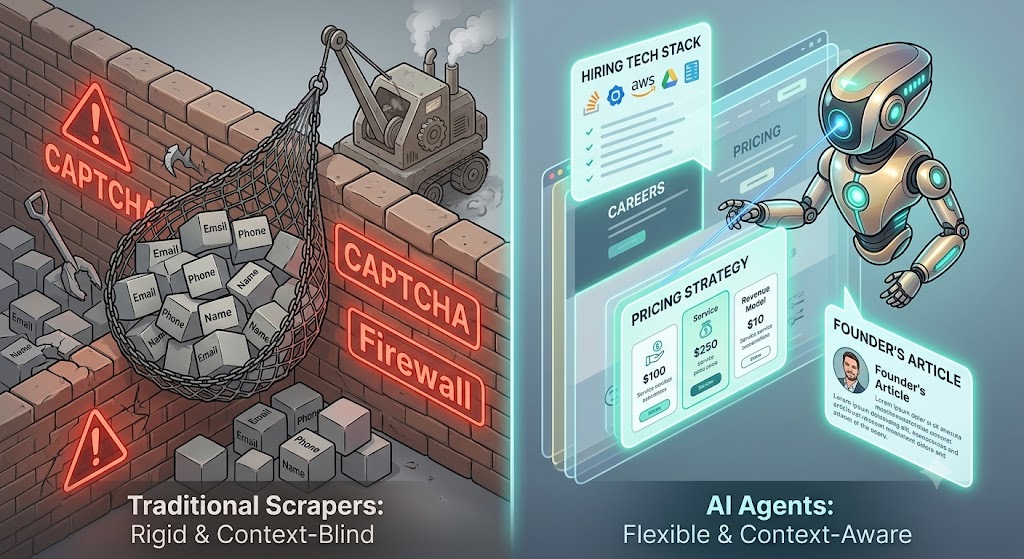
- Extremely Brittle: Traditional scrapers are rigid. The moment a target website updates its user interface, changes its layout, or modifies its HTML tags, the scraping script instantly breaks, requiring constant manual code maintenance.
- Raw Data Without Context: A scraper can easily extract raw text strings like a name, title, or email address. What it cannot do is interpret what that business actually does, its current pain points, or its market positioning.
- The Anti-Bot Wall: Modern websites protect their data fiercely. Traditional bots are easily detected, flagged, and blocked by firewalls like Cloudflare or CAPTCHA walls, leading to incomplete lists and burned IP addresses.
Ultimately, scraping treats lead generation as a volume game, leaving your sales team to clean up the mess.
2. The Rise of Autonomous AI Agents: Intellect Over Muscle
Autonomous AI Agents change the paradigm completely. Equipped with Large Language Models (LLMs) and native web-browsing capabilities, an AI Agent does not just execute a static script; it navigates the internet with an objective, making real-time decisions based on visual layout and semantic context.
Here is how an AI Agent reads, comprehends, and enriches lead data just like an elite human researcher:
- Analyzing Career Pages: Instead of just grabbing the HR manager’s email, an AI Agent can visit a target company’s “Careers” section. It reads job descriptions to decode their internal challenges and tech stack. For instance, if a target is hiring a “React Native Developer,” the Agent flags them as a prime lead for a mobile development agency.
- Deciphering Pricing Structures: An AI Agent can autonomously navigate to a prospect’s pricing page, analyze the tiers, and determine whether they target enterprise clients or SMEs. This allows your team to segment leads by purchasing power before the first email is even drafted.
- Synthesizing Multi-Channel Insights: The Agent seamlessly cross-references data from corporate blogs, recent press releases, and the Founder’s latest LinkedIn posts. It compiles these disparate pieces into a cohesive, highly tailored “trigger event”—the perfect golden hook for your outbound campaign.
3. Side-by-Side: Legacy Scraping vs. Autonomous AI Agents
To help evaluate your current operations, here is a clear breakdown of how the two technologies stack up across key operational pillars:
| Capability | Traditional Data Scraping | Autonomous AI Agents |
| Operational Mechanism | Strictly reliant on fixed HTML structures and pre-coded scraping paths. | Driven by logical reasoning, computer vision, and contextual language understanding. |
| Adaptability & Resilience | Breaks immediately when a website alters its layout or changes field positions. | Adapts dynamically to UI changes, scrolling, clicking, and navigating like a human. |
| Output Quality | Delivers raw, unfiltered spreadsheets often riddled with placeholder text or dead data. | Delivers fully enriched, highly contextual profiles ready for immediate outreach. |
| Security & Bypass Rate | Highly susceptible to IP blocks, rate limits, and standard CAPTCHA defense mechanisms. | Emulates natural human browsing behaviors, drastically reducing bot detection. |
4. Driving the Shift: Implementing AI Agents for a Lean Team
Transitioning to autonomous lead research does not require scrapping your existing workflow or undergoing a massive IT overhaul. For lean B2B teams, the most effective implementation strategy is introducing AI Agents directly into the environments your team already uses every day.
By leveraging inbox-native automation systems like Sald.io, your team can completely automate the enrichment cycle. The AI Agent works quietly in the background: identifying the prospect, browsing their digital footprint to find specific trigger points, and automatically drafting highly personalized icebreakers directly inside your inbox.
The operational impact is profound. By automating lead enrichment, B2B teams can slash manual research time by up to 90%. Your sales reps stop acting like online detectives and start focusing 100% of their energy on holding high-value conversations and closing deals.
5. Summary for B2B Leaders
In modern B2B sales, the company with the deepest contextual insights and the most personalized approach wins. Relying on legacy scraping to blast generic, high-volume email lists will only result in spam complaints and burned domains.
The future belongs to data depth, not just data volume. Upgrading from blind scraping to autonomous AI research ensures your sales pipeline is fueled by high-intent, thoroughly vetted opportunities. Give your growth team the leverage they need: stop scraping the surface, and let autonomous agents uncover the insights that actually convert.