
The Death of Generic Blasts: How to Scale Outbound Without Sounding Like a Bot

Every single day, thousands of B2B buyers open their inboxes to a wall of digital noise.
Sales Development Representatives (SDRs), growth marketers, and business development leads are sending millions of cold emails at unprecedented speeds. Yet, behind the scenes, campaign dashboards tell a heartbreaking story: Open rates are plummeting, reply rates are hovering near zero, and corporate domains are being burned at an alarming pace.
The strategy of “Blast & Pray”—uploading a static list of thousands of contacts into a sequence and firing off identical emails—is officially dead. Modern B2B buyers have developed an ironclad immunity to cold outreach. They can spot an automated template within three milliseconds of opening an email.
This creates a painful dilemma for growth teams:
- Option A: You send high-volume, generic emails to hit your pipeline targets, but your response rate tanks and your domain lands in spam.
- Option B: You spend 20 minutes manually researching each prospect to write a bespoke email, but you can only send 10 emails a day—making it impossible to hit your revenue goals.
Growth teams no longer have to choose between scale and quality. Personalization at scale is no longer about working harder or typing faster; it is about building modern, intelligent workflows.
By combining advanced multi-tier dynamic variables, real-time web scraping, and custom AI Icebreaker prompts, you can dispatch hundreds of hyper-personalized emails every day—where every single message feels like a 1-to-1, hand-written note from an industry peer.
1. The Death of Superficial Personalization
To understand why traditional cold email campaigns fail, we must look at how personalization has evolved over the last decade.
When automated mail merge tools first emerged, inserting a prospect’s first name into an email subject line was enough to double open rates. It felt personal because it was rare.
Today, basic tags are no longer considered personalization—they are considered the bare minimum for entry.
The 3 Eras of Cold Email Personalization:
- Era 1: Generic Blasts Mass email broadcasts with zero personalization and a generic sales pitch. Outcome: Immediate spam placement or ignored.
- Era 2: Basic Mail Merge Basic tags used (e.g., “Hi {{First_Name}}, I see you work at {{Company_Name}}”). Outcome: Buyers spot automation instantly.
- Era 3: AI Hyper-Personalization Real-time enrichment, custom AI Icebreakers, and a modular email structure. Outcome: High trust and 15%+ Reply Rates.
When a prospect receives an email that says:
“Hi Alex, I saw that you are the VP of Marketing at Acme Corp. Impressive record! I wanted to reach out and introduce our agency…”
Their brain immediately translates it to:
“This is an automated script. A bot scraped my LinkedIn profile title and company name, pasted it into a template, and sent this to 5,000 other people.”
Superficial tags fail because they do not demonstrate intent or effort. They show the recipient that you know who they are, but not what they care about right now.
To break through the noise, your emails must move beyond static database attributes and leverage Contextual Triggers.
2. Advanced Mail Merge: Multi-Tier Dynamic Variables
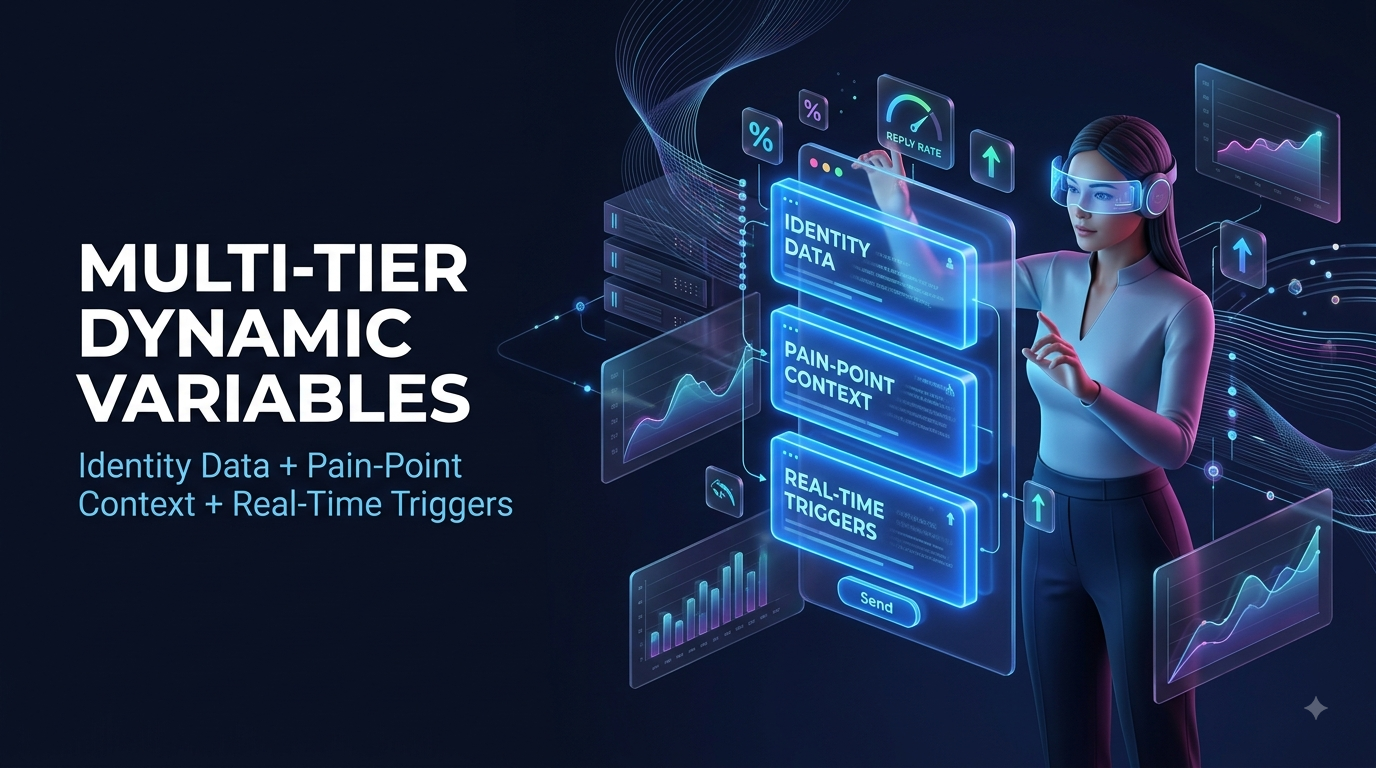
True personalization does not mean writing every word from scratch. Instead, it relies on a Modular Email Architecture.
An effective B2B outbound email is built using three distinct functional blocks:
- Block 1: The Contextual Icebreaker (100% Unique) – Generated dynamically per lead based on real-time external data.
- Block 2: The Core Value Proposition (Static / Segmented) – A sharp, proven explanation of the problem you solve for their specific industry persona.
- Block 3: The Call-to-Action (Dynamic) – Tailored based on the lead’s seniority, company size, or technology stack.
To power this architecture, growth teams use a Multi-Tier Dynamic Variable structure inside their sending platforms.
Tier 1: Identity Variables (The Baseline)
These are static contact properties pulled from standard database providers.
{{First_Name}}→ Alex{{Company_Name}}→ Acme Corp{{Title}}→ VP of Marketing
Tier 2: Industry & Pain-Point Variables (Contextual Segmentation)
These variables adapt the core pitch based on company parameters, ensuring the value proposition matches the prospect’s operational reality.
{{Industry_Challenge}}→ “managing rising customer acquisition costs across paid social”{{Competitor_Name}}→ “Beta Co”{{Current_Tech_Stack}}→ “HubSpot and Salesforce”
Tier 3: Real-Time Trigger Variables (Hyper-Personalization)
These variables capture recent, real-world events that give you a legitimate reason to reach out today.
{{Recent_Trigger_Event}}→ “your recent Series B funding announcement”{{LinkedIn_Post_Insight}}→ “your point on migrating to serverless architecture”{{Website_New_Hiring_Role}}→ “your active hiring push for Senior SDRs”
By assembling your emails using multi-tier variables, the structural template disappears, leaving behind a seamless, natural message that reads like a bespoke conversation.
3. Real-Time Data Scraping & Waterfall Enrichment
Where do you find high-intent, real-time data to power these dynamic variables? You cannot rely on static CSV files purchased six months ago. You must build an Automated Data Enrichment Pipeline.
Instead of manually browsing LinkedIn profiles or company press pages, modern outbound engines pull real-time data through API connectors and automated scraping workflows.
Key Real-Time Data Sources for B2B Outbound
- LinkedIn Profile & Activity Feed: What topics are prospects actively sharing? What did they write in their recent posts? Did they recently change positions or celebrate a company milestone?
- Corporate Website & News Outlets: Check recent press releases, fundraising announcements, corporate blog posts, and active job openings on their careers page.
- Job Boards & Hiring Pushes: Active job postings reveal operational bottlenecks. If a company is hiring five Senior Data Engineers, you know instantly that data infrastructure is a top priority.
The Power of Waterfall Enrichment
No single data provider contains complete, accurate information for every business prospect. If you rely on one data vendor, 30% to 40% of your leads will lack necessary fields.
To solve this, modern growth architectures use Waterfall Enrichment (using platforms like Clay, Apollo, or PhantomBuster).
Waterfall enrichment works like an automated cascade:
- The system checks Provider A for the prospect’s LinkedIn post data.
- If Provider A has no data, the system automatically routes the request to Provider B.
- If Provider B returns empty, it queries Provider C or triggers a live headless browser scrape.
This automated fallback loop ensures that 90%+ of your lead lists are enriched with real-time data before your campaign launches.
4. The AI Icebreaker Engine: Prompt Engineering Framework
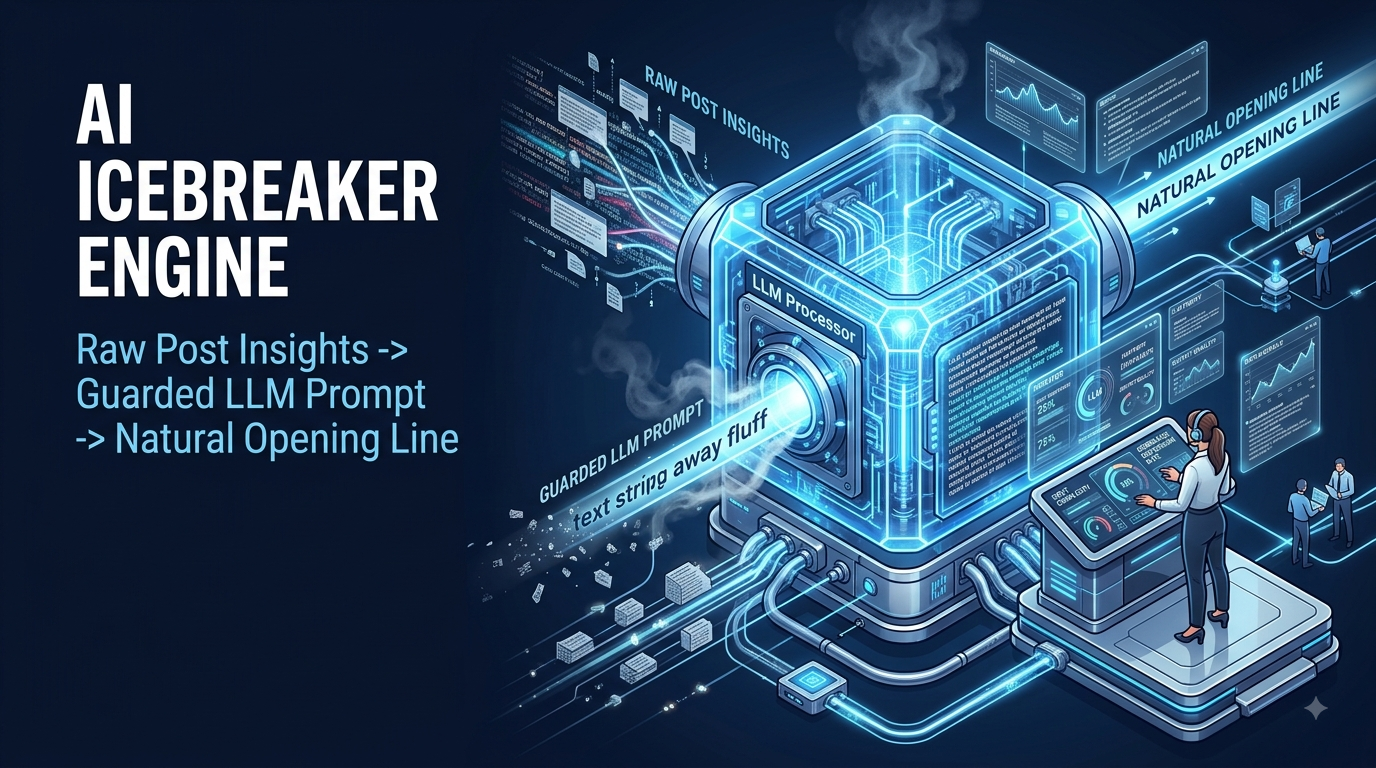
Once you have gathered raw real-time data (e.g., a prospect’s raw LinkedIn post or recent company press release), you face a technical challenge: Raw data is messy, verbose, and unformatted.
You cannot paste a 500-word LinkedIn post directly into an email line. You need a mechanism that reads the raw text, extracts the core sentiment, and synthesizes it into a concise, human-sounding 1-to-2 sentence opening line.
This is where Large Language Models (LLMs) like GPT-4o or Claude 3.5 Sonnet act as your automated copywriting assistant.
The Anatomy of an Effective AI Icebreaker Prompt
Most AI-generated emails sound robotic because users give the LLM vague instructions, such as: “Write a personalized compliment based on this LinkedIn post.”
This results in overly polite, unnatural, and praise-heavy text that immediately flags the email as artificial.
To generate authentic icebreakers, your prompt must include strict Guardrails and Formatting Rules:
- Role Definition: Act as an expert B2B SDR writing a 1-to-1 cold email opening line to a peer.
- Tone Guardrails: Conversational, direct, casual, and completely un-robotic.
- Negative Constraints: Do NOT use flattery (e.g., avoid “Incredible post!”, “Fascinating insights!”). Do NOT use corporate buzzwords (e.g., avoid “synergy”, “game-changer”).
- Opening Ban: Do NOT start with “I noticed that you…”, “I came across your…”, or “I saw your post about…”.
- Length Restriction: Strictly keep the output under 25 words total (a single complete sentence).
Real-World Transformation: Before vs. After AI Prompting
To see the power of strict prompt guardrails, compare how different tools process the exact same raw data input.
- Raw Lead Data Input: A LinkedIn post by a VP of Engineering discussing how their team reduced AWS infrastructure costs by 30% by migrating to spot instances.
- ❌ Standard Bot Output (Vague Prompting): “Hi Alex, I hope you are having a wonderful week! I saw your incredible post about AWS costs and I was so impressed by your leadership at Acme Corp. Truly revolutionary work!” (Result: Prospects immediately spot the fake flattery and delete the message.)
- 🟢 Guarded AI Engine Output (Master Prompting): “Hi Alex, caught your note on switching to AWS spot instances—smart move on cutting idle cluster overhead without hitting deploy delays.” (Result: Reads exactly like a peer-to-peer technical comment, establishing instant domain authority.)
5. Technical Breakdown: 3 Levels of B2B Outbound Execution
Here is the technical contrast between traditional outbound tactics and modern AI hyper-personalization:
Level 1: Generic Mass Blasts (Legacy Outbound)
- Tech Stack: Basic bulk email platforms.
- Data Quality: Static CSV lists bought from low-tier contact databases.
- Personalization Depth: 0% (Identical message sent to thousands).
- Avg. Reply Rate: Below 0.5% (High risk of domain blacklisting).
Level 2: Basic Mail Merge (Standard Sales Operations)
- Tech Stack: Standard sales engagement software.
- Data Quality: Static database enriched once with basic contact attributes.
- Personalization Depth: 10% – 15% (First name, company name, job title).
- Avg. Reply Rate: 1.5% – 3.0% (Recognizable automation).
Level 3: AI Hyper-Personalization (Modern Growth Stack)
- Tech Stack: Direct Native API + Real-time Waterfall Enrichment (Clay/Apollo) + LLM Prompt Engine.
- Data Quality: Dynamically scraped, live LinkedIn and website data refreshed at campaign launch.
- Personalization Depth: 85% – 95% (Unique AI Icebreaker + Tiered Dynamic Variables).
- Avg. Reply Rate: 10% – 22%+ (Authentic 1-to-1 conversation).
6. Step-by-Step Blueprint to Build Your Hyper-Personalized Engine
Ready to upgrade your outbound engine? Here is the exact step-by-step workflow to build an automated, hyper-personalized B2B campaign.
Step 1: Define Your Target ICP & Intent Triggers
Identify specific trigger events that make your prospect receptive to a solution today: Are they hiring for specific skill sets? Did they recently secure funding? Has key leadership changed hands in the last 90 days?
Step 2: Build Your Data Scraping and Enrichment Table
Set up a data table (using platforms like Clay) to ingest raw lead inputs and run automated enrichments:
- Import Target Contacts: Load your list of target domain accounts and decision-maker titles.
- Scrape LinkedIn Activity: Run an automated action to pull the text of the lead’s most recent post or “About” section.
- Scrape Corporate News: Query the target domain for recent press releases or blog posts published in the last 30 days.
Step 3: Configure the AI Prompt Engine
Pass the raw scraped text into your LLM prompt module (GPT-4o or Claude 3.5 Sonnet). Apply strict formatting guardrails (max 25 words, zero buzzwords, single sentence).
Crucial Step: Add an Automated Fallback Filter. If a prospect has zero recent activity or posts online, instruct the LLM to output a clean, segment-specific default line instead of inventing false information.
Step 4: Assemble the Modular Email Inside Your Sending Tool
Connect your enriched data table directly to your cold email sending platform via API or CSV export. Map your dynamic columns into your modular template:
- Subject Line:
Quick question regarding {{Company_Name}}'s {{Core_Initiative}} - Line 1 (Dynamic Icebreaker):
{{AI_Generated_Icebreaker}} - Line 2 (Value Proposition):
We help {{Industry_Type}} teams solve {{Specific_Pain_Point}} without {{Common_Frustration}}. - Line 3 (Call-to-Action):
Open to taking a look at a 2-minute video on how we tackled this for {{Competitor_Name}}?
Step 5: Execute Throttled Delivery and Monitor Reply Loops
Deploy your campaign using Native Gmail/Workspace API Connections and Safety Throttling:
- Cap volume at 30 to 50 emails per day per inbox.
- Randomize sending intervals (3 to 7 minutes between outgoing emails).
- Track your Positive Reply Rate as your primary success metric. High reply rates tell email service providers that your content is valuable, keeping your messages permanently landed in the Primary Inbox.
7. Frequently Asked Questions (FAQs)
- Isn’t setting up real-time enrichment and AI prompts too expensive for small sales teams? No. Modern data platforms offer pay-as-you-go credit models. While running an AI enrichment pipeline adds a small cost per lead (a few cents per contact), getting a 15% reply rate from 500 hyper-personalized emails generates far more revenue than getting a 0.5% reply rate from 10,000 spam blasts—while protecting your domain reputation.
- What happens if a prospect has no LinkedIn activity or news online? This is why an Automated Fallback System is essential. Your AI prompt must be configured with conditional logic: If no recent activity exists, output a pre-written, highly relevant industry-specific opening line. Never let an AI hallucinate or invent fake facts about a prospect.
- Will AI-generated icebreakers sound robotic to smart B2B buyers? They will sound robotic only if you use weak prompts that encourage flattery, buzzwords, and corporate filler. When you enforce strict guardrails—limiting word count, banning praise, and forcing the model to focus on concise technical observations—the output becomes indistinguishable from a message typed by a human peer.
- Should I still track email open rates to measure personalization success? Open rates have become increasingly unreliable due to privacy features like Apple Mail Privacy Protection (MPP), which automatically load tracking pixels and inflate open stats. The ultimate metric for outbound campaign success is Positive Reply Rate.
Conclusion
The age of spraying thousands of template emails across the internet is officially over. Buyers are too smart, inbox filters are too advanced, and domain penalties are too severe.
Scaling outbound sales in the modern era does not mean sending more noise; it means building smarter workflows.
By combining multi-tier dynamic variables, real-time waterfall data enrichment, and strict AI prompt engines, you transform cold email from an intrusive numbers game into a precise, value-driven conversation channel.
Stop blasting the market. Build your hyper-personalization engine, respect your prospect’s time, and claim your place where real revenue is generated: The Primary Inbox.