
The Economics of Retention: How Post-Purchase Automation Drives CLTV
In the early days of e-commerce and direct-to-consumer (DTC) digital marketing, the math was simple. You spent money on Facebook ads, you generated traffic, you acquired a customer, and you made a profit on that first purchase. Repeat the cycle, and the business scaled gracefully.
Today, that math is not just outdated; it is broken.
We have entered a period described as the “CAC Trap,” a challenging landscape where Customer Acquisition Costs (CAC)—the total expense of acquiring a single new customer—have skyrocketed. Driven by Apple’s iOS privacy changes, saturated advertising channels (Meta, Google, TikTok), and intense corporate competition, the primary fuel of acquisition-driven growth has become too expensive.
Most e-commerce and retail brands now lose money, or at best break even, on the initial sale. The business model cannot sustain itself on acquisition alone.
The true breakthrough in profit—the path to scaling from $1M to $10M and beyond—does not hide in a better ad campaign. It lies in The Economics of Retention. The real revenue engine is optimizing Customer Lifetime Value (CLTV) by ensuring that the customers you already have return to purchase again and again.
Sustainable profitability is achieved not when you buy your next customer, but when you buy back your own customers’ future attention, loyalty, and purchase frequency. To execute this at scale, without ballooning your operational overhead, modern organizations must deploy Post-Purchase Automation. This strategic system converts a single transaction into a continuous, compounding financial engine that expands CLTV entirely on autopilot.
1. The Financial Reality: Deconstructing the CAC vs. CLTV Ratio
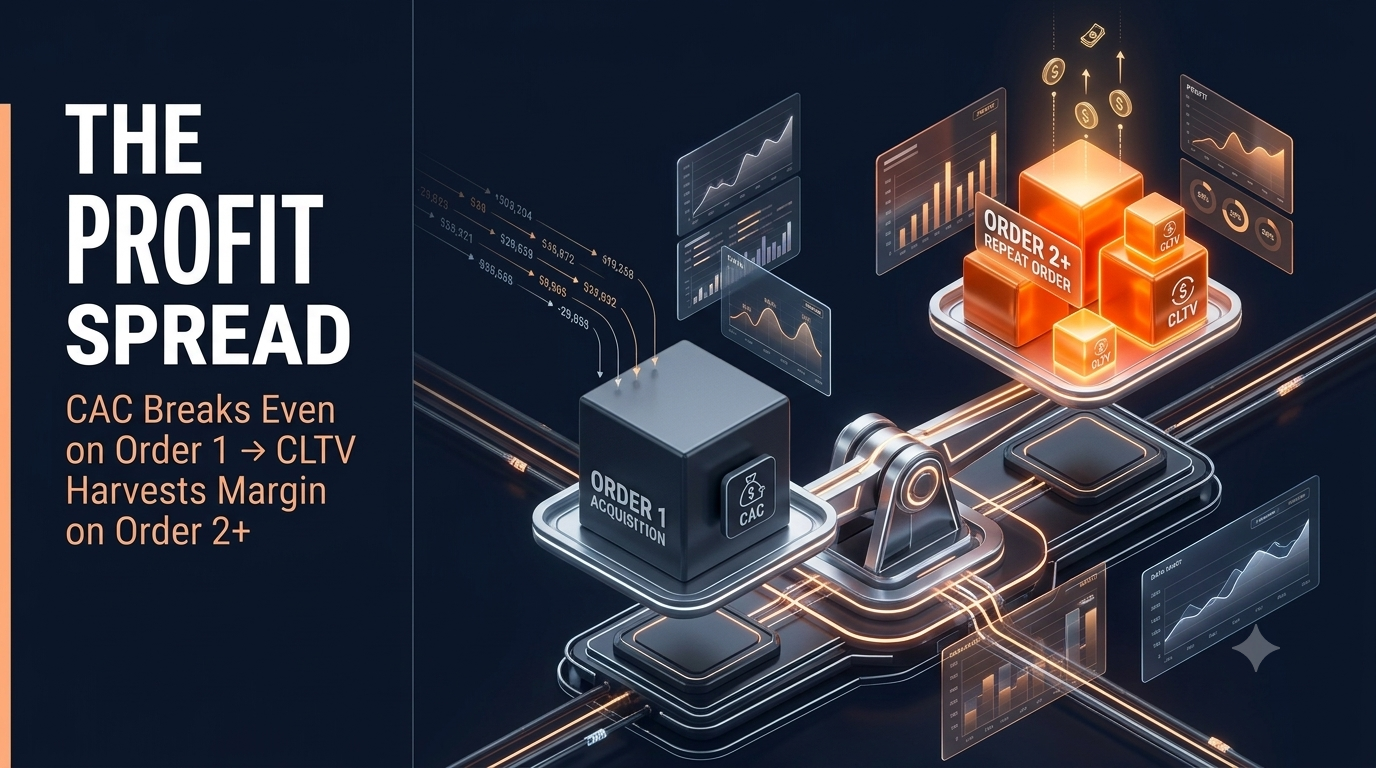
To escape the “CAC Trap,” founders, CMOs, and growth leads must adopt an analytical mindset. Retention is not a “fuzzy” concept defined by goodwill and pleasant customer service; it is a rigid model rooted in financial mathematics. Profitability is determined by the specific spread between your Customer Acquisition Cost (CAC) and your Customer Lifetime Value (CLTV).
Defining the Core Financial Variables
Understanding your operational health requires clarity on two defining metrics:
-
Customer Acquisition Cost (CAC): The total cost (all marketing spend, software, and personnel) divided by the number of new customers acquired in a specific period. (e.g., $10,000 spend / 100 customers = $100 CAC).
-
Customer Lifetime Value (CLTV): The total predicted net profit that a single customer will contribute to your business over the entire duration of their relationship with your brand. (e.g., A customer buys $100 worth of products three times, contributing $150 in total gross profit. CLTV = $150).
Understanding the 5x Rule: Why Retention is Mathematically Cheaper
The core financial argument for retention can be summarized in a simple operational heuristic:
It is generally accepted that it costs five to seven times more to acquire a single new customer than it does to retain an existing one.
When you acquire a new customer, you must pay Meta for the ad impression, Google for the search click, and perhaps an influencer for the endorsement. When you retain an existing customer, your variable cost is nearly zero. You are sending an automated email or SMS—the variable cost of communication is microscopic.
The Compounding Contribution Margin: Acquisition vs. Retention
Let us analyze the financial cascade of a single customer over three distinct orders, highlighting the profound impact on profit:
Operational Stage: Order 1 (Acquisition)
-
Customer is acquired via a paid social ad campaign.
-
Revenue: $100
-
COGS & Logistics: -$40
-
Variable Cost: CAC: -$50 (A healthy 2:1 initial ROAS)
-
Resulting Net Profit (Contribution Margin): $10 (A razor-thin margin)
Operational Stage: Order 2 (Retention – Driven by Automation)
-
Customer returns via a free automated replenishment sequence.
-
Revenue: $100
-
COGS & Logistics: -$40
-
Variable Cost: CAC: $0 (Acquisition already paid)
-
Resulting Net Profit (Contribution Margin): $60 (600% increase in profit per order)
Operational Stage: Order 3 (Loyalty – Driven by Anniversary Flow)
-
Customer returns via an automated VIP tiered anniversary offer.
-
Revenue: $120 (Avg. Order Value increased by upsell)
-
COGS & Logistics: -$48
-
Variable Cost: CAC: $0 (Retention driven by free email)
-
Resulting Net Profit (Contribution Margin): $72 (An even higher compounding profit)
The mathematics are undeniable: True profitability is harvested only on the second, third, and fourth purchases. A retention-focused organization does not try to maximize Order 1; it maximizes Orders 2, 3, and 4.
The Ideal Ratio for Scale
To operate a financially sustainable growth model, your organization must maintain an ideal balance between these two variables.
-
A CLTV:CAC ratio of < 1:1 is fatal. You are losing money on every acquired customer.
-
A CLTV:CAC ratio of 1:1 or 2:1 is unstable. You are breaking even, but there is zero margin for error or scale.
-
A CLTV:CAC ratio of 3:1 is the definitive standard for operational health. This provides sufficient margin to cover overhead, reinvest in product, and finance future growth.
2. The Exponential Power of the Retention Rate
A foundational study conducted by Frederick Reichheld of Bain & Company (creator of the Net Promoter Score) and researchers from Harvard Business School quantified the true leverage of retention.
A microscopic 5% increase in your customer retention rate can result in a total bottom-line profit increase of 25% to 95%.
This geometric impact happens because existing customers exhibit compounding behavioral advantages. They have higher Average Order Values (AOV), they convert at higher rates, and they naturally advocate for your brand, providing free “earned media” that further suppresses your blended CAC.
Retention acts as the ultimate amplifier in your e-commerce financial engine. By shifting 5% more first-time buyers into repeat purchase status, you are increasing the overall utilization and ROI of your initial marketing investment across the board.
3. The Architecture of a High-ROI Post-Purchase Automation System
Knowing you must retain customers is different from knowing how to retain them at scale. True retention economics cannot rely on manual effort. If your customer service team must individually message every past purchaser, you have traded a marketing expense for an unscalable operational bottleneck.
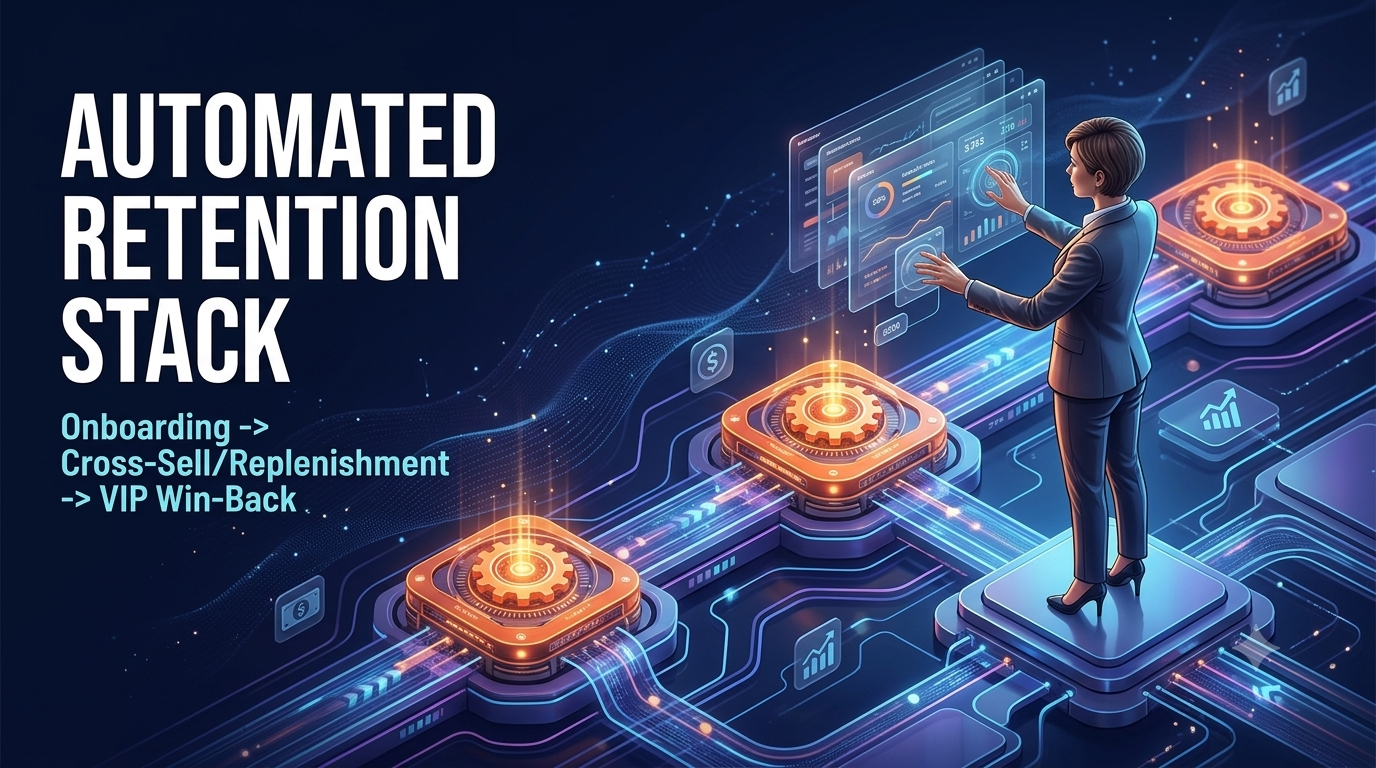
Modern retention must be engineered. You need a Post-Purchase Automation System: A series of automated, behavioral-triggered email and SMS sequences that manage the entire customer relationship after the initial click of the “buy” button.
Why Automation is the Retention Lever
Unlike manual communication, a native automation system (e.g., running via Klaviyo, Sendlane, or Attentive) provides three distinct operational advantages:
-
Microscopic Operational Overhead: The cost of sending 10 automated emails is identical to the cost of sending 1,000,000. You break the linear link between customer volume and labor costs.
-
Behavioral Precision: Automation does not guess; it reacts. A retention flow triggers the perfect message (e.g., a cross-sell of a complementary accessory) at the perfect time (e.g., 14 days after the initial product delivery) based on that individual’s exact purchase history.
-
1:1 Personalization at Scale: By utilizing dynamic data tags, automation delivers messages tailored to the specific customer’s product choices, first name, and predicted next need.
Anatomy of an High-Performing Post-Purchase Automation Stack
A robust post-purchase system is divided into three distinct operational sequences, each with a specific financial goal.
Sequence 1: Onboarding and De-risking (0 – 14 Days After Delivery)
Financial Goal: Eliminate “Buyer’s Remorse” and Prevent Churn.
The most dangerous moment in the customer lifecycle is immediately after they have trusted you with their credit card. If they regret the purchase, cannot figure out how to use the product, or have a poor delivery experience, they will churn (never return) or, worse, initiate a chargeback.
-
Message 1 (Immediate): The Thank You & Brand Story. Express sincere gratitude, validate their purchase choice, and welcome them into your brand community. Show them the mission they are now part of.
-
Message 2 (Upon Delivery): Product Education. Do not assume they know how to maximize the product. Deliver a tutorial, a “Quick Start” guide, or a FAQ to ensure the first experience is frictionless and high-satisfaction.
-
Message 3 (7-10 Days): Social Proof & Community Invite. Show them how other customers are succeeding with the product. Invite them to join your VIP community, submit a review, or share a photo on social media.
Sequence 2: The Cross-sell and Replenishment Engine (21 – 60 Days)
Financial Goal: Drastically Increase Average Order Value (AOV) and Order Frequency.
Once a customer is satisfied with their initial purchase, the economic engine must actively look for opportunities to service their next need.
-
The Cross-Sell/Upsell Flow: If they bought a shampoo, offer the matching conditioner. If they bought a coffee maker, cross-sell the premium bean subscription. This email triggers automatically 21 days after the first purchase, showing dynamic recommendations based on their exact cart contents.
-
The Replenishment Flow: If your product is a consumable (supplements, skincare, coffee, pets), this email is the “ROI King.” If your data shows the average bottle of Vitamin C lasts 30 days, trigger an email on Day 25: “Is your bottle running low? Lock in your next order now to ensure you don’t miss a day.“
Sequence 3: The Win-back and Loyalty Sequence (90 – 365+ Days)
Financial Goal: Reactivate Stagnant Customers and Increase Brand Affinity.
Every customer list contains a “stagnant” segment—past buyers who have not returned for months. Ignoring them is identical to ignoring thousands of dollars in “earned revenue.“
-
The “We Miss You” Win-Back Flow: This triggers automatically if a customer has not made a purchase within 90 days (or 2x your Average Purchase Frequency). Send a “Check-In” email, followed by a time-sensitive, dynamic offer (e.g., 15% off their next cart) to reactivate them.
-
The Anniversary & VIP Flow: Celebrate their loyalty milestone: “Congratulations! You made your very first order with us one year ago today.” Reward high-value customers with exclusive status: “Welcome to the VIP Tier! You now get free shipping on all orders.” This is an entirely automatic way to increase emotional brand connection and purchase intent.
4. Key Financial Metrics for the Retention Dashboard
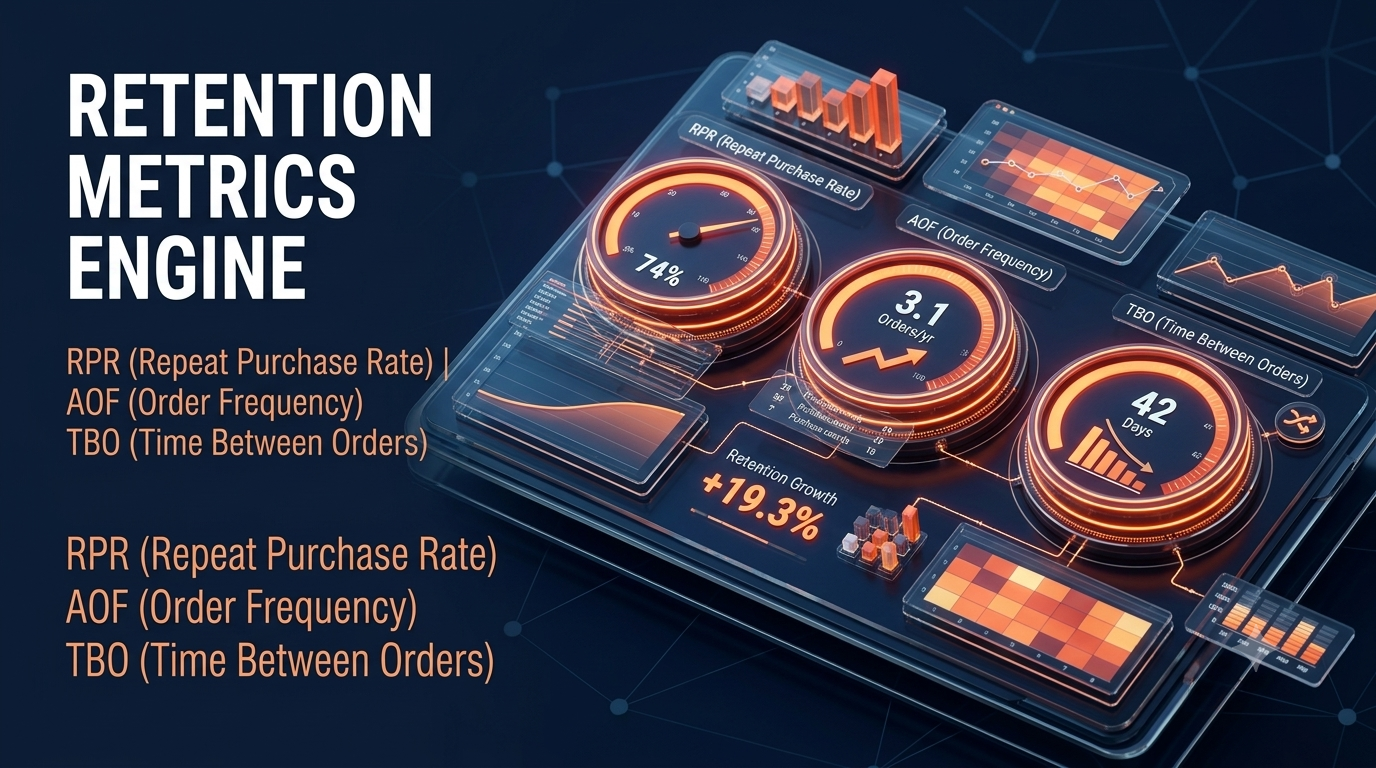
In the same way you manage ad performance, you must manage your retention engine using specific Leading Indicators. To monitor your operational effectiveness, you must track three critical metrics.
Key Metric 1: Repeat Purchase Rate (RPR)
Description: The percentage of customers who have made more than one purchase over a given period (usually measured over 12 months).
Why it Matters: The Repeat Purchase Rate is the baseline indicator of product market fit and successful automated onboarding. A rising RPR proves your initial customers are finding value and that your automated sequences are working.
Key Metric 2: Average Order Frequency (AOF)
Description: The average number of orders each individual customer places within a specific period (e.g., 1.8 orders per customer per year).
Why it Matters: AOF is the primary counter-lever to a high CAC. Increasing AOF from 1.2 to 2.1 has the same financial impact as dropping your CAC by 50%—without spending a single extra dollar on Meta ads.
Key Metric 3: Time Between Orders (TBO)
Description: The average number of days or months between a customer’s first purchase and their second purchase (or second and third).
Why it Matters: TBO is the essential operational variable used to set your automation triggers. If your Average TBO is 45 days, sending a replenishment email on Day 60 is too late. You must send it on Day 40 to intersect that behavioral intent.
Protecting Your Bottom Line with a Lean, Unified Engine
In today’s volatile market, business success is rarely determined by which organization runs the most aggressive ad campaigns. Instead, victory belongs to the organizations that execute with the highest operational velocity and the lowest capital burn rate.
Every dollar wasted on inefficient point solutions or a fragmented, unscalable sales stack is a dollar stolen directly from your product development, marketing experiments, and your financial runway. Continuing to operate with a bloated, multi-tool stack is not just inefficient—it is financially dangerous.
Do not force your growth, sales, and operations teams to navigate a chaotic maze of disconnected web applications. Embrace the philosophy of The Lean Inbox today. Consolidate your outreach, automate your research, and manage your entire client ecosystem directly from your central inbox.
By bringing powerful, context-aware automation directly to where your business naturally happens, you not only unlock immediate software cost reductions; you liberate your talent from administrative overhead and protect your startup’s bottom line.